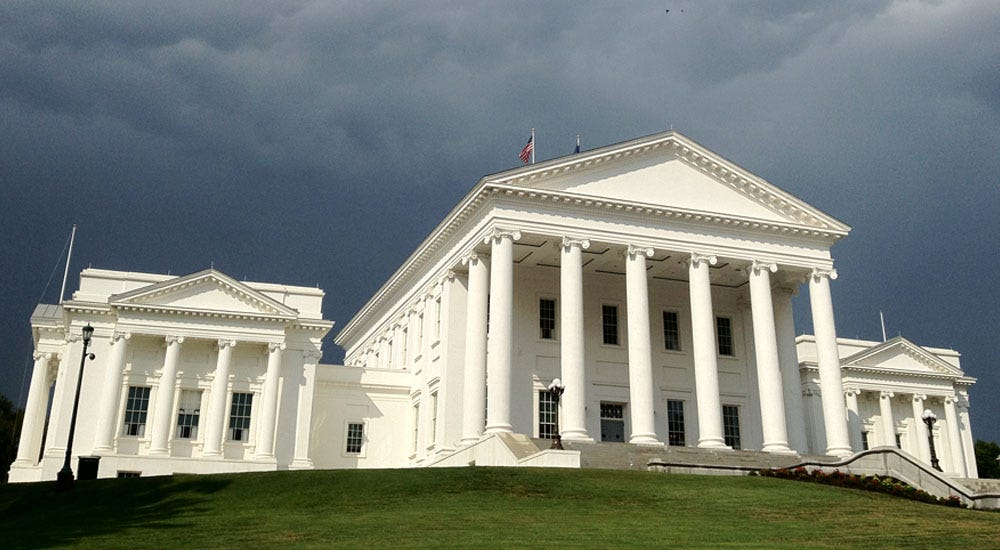
 Virginia State Capitol From South Cloudy.jpg | TallTreesPhilip | CC BY-SA 4.0
The Permanence of Principle in an Age of Expedience**
*Reflections on the Virginia Spring Session and the Enduring Questions of Republican Government*
The dogwoods are in bloom across Virginia this May morning, their white petals catching the early light as they have for centuries before the first colonial settlement, before Jefferson penned his Notes on the State of Virginia, before Madison walked the grounds at Montpelier wrestling with the mechanics of faction and representation. There is something profoundly stabilizing about this annual resurrection of beauty, something that speaks to permanence amid the temporal chaos of political seasons.
As I write this, the Virginia General Assembly has just concluded its spring session—a brief but telling affair that revealed more about the trajectory of our Commonwealth than the rushed votes and partisan positioning might suggest to the casual observer. The legislative theater we witnessed these past weeks serves as a crystalline example of what Edmund Burke warned against: the substitution of abstract theory for prudential wisdom, the elevation of ideological purity over the patient work of governance.
## The Youngkin Administration at the Crossroads
Governor Glenn Youngkin approaches the twilight of his single term with a record that defies easy categorization—precisely the kind of complexity that our increasingly binary political discourse struggles to accommodate. His administration's handling of the recent teacher shortage crisis exemplifies both the promise and the limitations of executive leadership in our federal system.
The Governor's proposal to expand alternative certification pathways for educators, while maintaining rigorous standards, represents the kind of incremental reform that Burke would have recognized as genuinely conservative—that is, conserving what works while adapting to changed circumstances. Yet the General Assembly's Democratic majority, still smarting from their 2023 losses in the House of Delegates, approached these proposals with the reflexive opposition that has become the hallmark of our degraded political culture.
What struck me most forcefully during the floor debates was not the predictable partisan choreography, but the absence of any serious engagement with the philosophical questions that underlie educational policy. Are we preparing young Virginians for citizenship in a self-governing republic, or are we merely credentialing them for participation in a technocratic administrative state? The distinction matters profoundly, yet it was never addressed in the rush to score political points.
## The Congressional Delegations and the National Question
The recent redistricting adjustments following the 2025 census have rendered Virginia's 5th and 7th Congressional districts into fascinating laboratories of American political evolution. VA-05, stretching from the Piedmont to the Blue Ridge, now encompasses communities where Thomas Jefferson's vision of the yeoman farmer meets the reality of 21st-century economic dislocation. The district's Republican representative faces the unenviable task of representing constituents whose material interests often conflict with the abstract principles of free-market orthodoxy.
Meanwhile, VA-07's transformation into a genuinely competitive seat reflects the broader demographic and cultural changes reshaping the Commonwealth. The exurban counties that once provided reliable Republican majorities now house populations whose relationship to traditional party loyalties grows increasingly attenuated. These voters—many of them refugees from the dysfunctions of urban governance—seek not ideological purity but competent administration and respect for their aspirations to ordered liberty.
The challenge facing Virginia's Republican representatives is not merely tactical but philosophical. How does a party rooted in the Burkean tradition of organic development respond to the legitimate grievances of citizens who feel abandoned by both market forces and administrative bureaucracy? The answer cannot be found in the sterile formulations of think-tank policy papers, but requires the kind of prudential judgment that comes only from deep engagement with the actual conditions of human flourishing.
## The Madisonian Moment
This brings me to a consideration that has occupied my thoughts throughout this legislative session: the enduring relevance of James Madison's insights into the mechanics of republican government. Madison understood, as our contemporary political class apparently does not, that the preservation of liberty requires not the triumph of any particular faction, but the careful balancing of competing interests within a framework of constitutional constraint.
The current polarization of Virginia politics—reflected in the General Assembly's increasingly rigid partisan divisions—represents precisely the kind of factional dominance that Madison feared would destroy republican government from within. When the Democratic majority reflexively opposes every Youngkin initiative, regardless of merit, they abandon the patient work of deliberation that makes self-government possible. When Republicans respond with equally reflexive obstructionism, they compound the problem.
What we are witnessing is not healthy political competition but the degradation of politics into mere tribal warfare. The casualties of this degradation are not merely the immediate policy objectives of either party, but the civic virtues upon which republican government depends: prudence, moderation, and the capacity for reasoned public discourse.
## The Religious Liberty Crucible
Nowhere is this degradation more evident than in the ongoing disputes over religious liberty that have dominated much of the Assembly's attention this session. The proposed amendments to the Virginia Religious Freedom Restoration Act reveal the profound confusion that characterizes our public discourse about the relationship between faith and governance.
The secular progressive position, as articulated by several Democratic delegates during the floor debates, rests on the assumption that religious conviction represents a kind of cognitive error—a failure to embrace the supposedly neutral rationality of secular humanism. This assumption blinds its adherents to the obvious fact that secular humanism is itself a comprehensive worldview with its own metaphysical commitments, its own account of human nature and destiny.
The traditional conservative response, unfortunately, often proves equally inadequate. The tendency to treat religious liberty as merely one interest among others to be balanced against competing claims fundamentally misunderstands the nature of the question at stake. Religious liberty is not simply about protecting the preferences of religious minorities, but about preserving the space for the kind of transcendent allegiance that prevents the state from becoming totalitarian.
Roger Scruton understood this point with characteristic clarity: a society that acknowledges no authority higher than the state inevitably becomes tyrannical, because it recognizes no limits to political power. The current assault on religious liberty, disguised as concern for anti-discrimination, represents not progress but regress—a return to the kind of caesaropapism that the American founding generation explicitly rejected.
## The Media and the Manufacture of Unreality
The coverage of these legislative debates in Virginia's mainstream media provides a depressing illustration of the broader crisis facing American journalism. Rather than helping citizens understand the substantive questions at stake, our media institutions have become engines for the manufacture of ideological conformity.
Consider the reporting on the recent education funding debates. The Richmond Times-Dispatch's coverage focused almost exclusively on the political horse-race aspects of the legislation—who was winning, who was losing, what it meant for the next electoral cycle. The substantive question of how best to educate young Virginians for citizenship in a free society was relegated to a few perfunctory paragraphs buried deep in the story.
This represents more than journalistic malpractice; it reflects the deeper corruption of our information ecosystem by the logic of commercial entertainment. When news becomes a product to be consumed rather than information necessary for self-governance, citizens inevitably become less capable of the kind of sustained attention that democratic deliberation requires.
The alternative media landscape offers little improvement. The proliferation of ideologically segmented news sources allows citizens to inhabit increasingly isolated information bubbles, consuming only those narratives that confirm their existing prejudices. The result is not a more informed citizenry but a more polarized one, less capable of the kind of reasoned disagreement that healthy political communities require.
## The Utopian Temptation
Underlying many of these specific policy disputes is a broader philosophical question that Americans have been wrestling with since the founding: the relationship between human nature and political possibility. The secular progressive vision that animates much contemporary Democratic politics rests on fundamentally utopian assumptions about the malleability of human nature and the capacity of political action to eliminate the sources of human suffering.
This utopianism manifests itself in countless ways: the belief that proper legislation can eliminate inequality, that the right educational policies can perfect human character, that sufficient government programs can create the conditions for universal flourishing. Each of these beliefs rests on the assumption that human nature is infinitely plastic, that the sources of human misery are external and therefore politically remediable.
The conservative tradition, rooted in the insights of thinkers like Burke and Scruton, offers a more modest but ultimately more humane understanding of political possibility. It recognizes that human nature is flawed but not perfectible through political means, that the sources of human suffering are often internal and spiritual rather than external and material, that the proper goal of government is not the creation of paradise but the preservation of conditions under which human beings can pursue their own vision of flourishing within appropriate constraints.
This does not mean abandoning the effort to ameliorate suffering or improve conditions for human flourishing. It means pursuing these goods through means that acknowledge rather than deny the permanent realities of human nature. It means preferring incremental reform to revolutionary transformation, local knowledge to abstract theory, the wisdom of tradition to the conceits of ideology.
## The Founding Generation's Legacy
As we navigate these contemporary challenges, we would do well to remember that the founding generation faced similar questions about the relationship between principle and prudence in political life. Jefferson's famous declaration that "the earth belongs to the living" reflected not casual disregard for tradition but sophisticated understanding that each generation must appropriate its inheritance in ways suited to its particular circumstances.
Madison's contributions to the constitutional convention demonstrated similar sophistication. His theoretical understanding of republican government was always tempered by careful attention to the practical requirements of implementation. The Constitution he helped craft reflects not abstract perfection but prudential judgment about what was possible given the materials at hand—the existing state governments, the economic interests of different regions, the religious and cultural diversity of the American people.
This founding wisdom offers crucial guidance for Virginia Republicans as they contemplate their future. The temptation will be either to retreat into ideological purity or to abandon principle altogether in pursuit of electoral success. Neither path leads to the kind of leadership that Virginia needs.
## The Path Forward
What Virginia needs—what America needs—is political leadership rooted in what I would call "constitutional conservatism": a vision that takes seriously both the permanent principles of human flourishing and the particular requirements of governing actual human communities in specific times and places.
Such leadership would begin with humility about the limits of political action while maintaining conviction about the importance of political responsibility. It would prefer the patient work of building institutions to the theatrical gestures that dominate contemporary political culture. It would recognize that the health of republican government depends not on the triumph of any particular party but on the cultivation of civic virtues that transcend partisan allegiance.
For Virginia conservatives, this means recovering a vision of politics that goes beyond mere opposition to progressive excess. It means articulating a positive account of human flourishing that can speak to the legitimate concerns of citizens across the political spectrum. It means defending the Anglo-American tradition of ordered liberty not as a partisan weapon but as a genuine alternative to both authoritarian statism and libertarian individualism.
The dogwoods will bloom again next spring, as they have for millennia, indifferent to our political anxieties and ideological disputes. But whether Virginia will continue to serve as a laboratory for republican government depends on whether we can recover the civic virtues that make self-governance possible. The choice, as always, remains ours to make.
*Shaun Kenney served as executive director of the Republican Party of Virginia and currently writes on politics and culture from his home in Fluvanna County.*