Democrats and the Problem of Maximum Warfare
When von Clausewitz argued that warfare is politics by other means, too many people adopted the obverse as a truism as well: that politics should be warfare by ...
When von Clausewitz argued that warfare is politics by other means, too many people adopted the obverse as a truism as well: that politics should be warfare by other means.
That’s wrong.
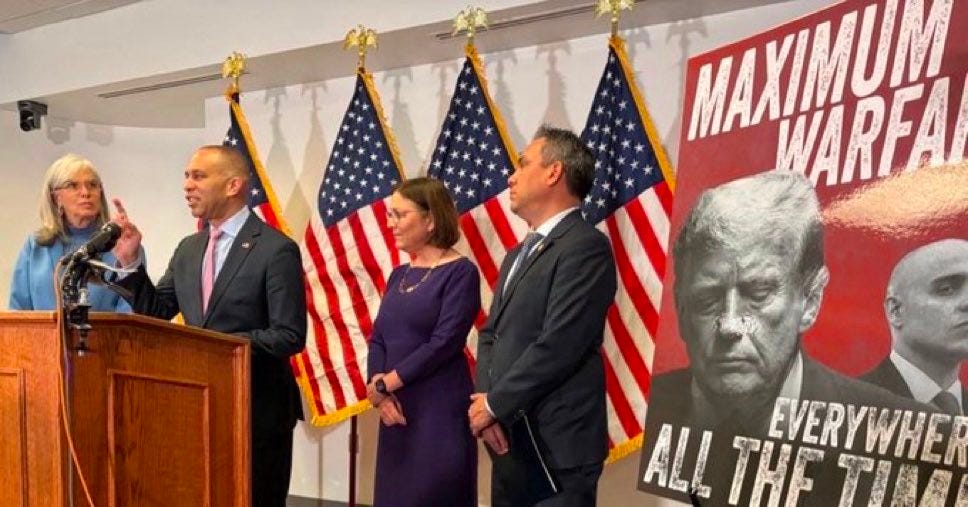
Case in point. On Wednesday, Representative Hakeem Jeffries — after spending tens of millions of dollars on what was arguably an unconstitutional power grab — decided to hold a press conference calling for totaler krieg against the Trump Administration.
I’m not precisely sure how one dials back that kind of sentiment. Imagine for a moment if Republicans did likewise with a call for maximum warfare against Democrats. Would we ever live it down? Would we have the right to live it down until that leadership changed?
This isn’t a football the Democrats can hide anymore.
From Jeffries own press statement, there is a pledge to demand “maximum warfare, everywhere, all the time” against Republicans. Outside the White House Correspondents Dinner there were signs advocating for just that — with maximalist rhetoric:
All wearing masks. Gee — I wonder why?
The manifesto of the would-be assassin doesn’t make the case any better. Cole Tomas Allen — a CalTech graduate and by no means a weak mind — made his movitations clear in a multi-page manifesto sent to friends and family minutes before his attempt. The rhetoric used is just about what you would expect and often times hear from the political left:
On to why I did any of this:
I am a citizen of the United States of America.
What my representatives do reflects on me.
And I am no longer willing to permit a pedophile, rapist, and traitor to coat my hands with his crimes.
(Well, to be completely honest, I was no longer willing a long time ago, but this is the first real opportunity I’ve had to do something about it.)
This isn’t lawmaking. This isn’t for the common good. This isn’t political.
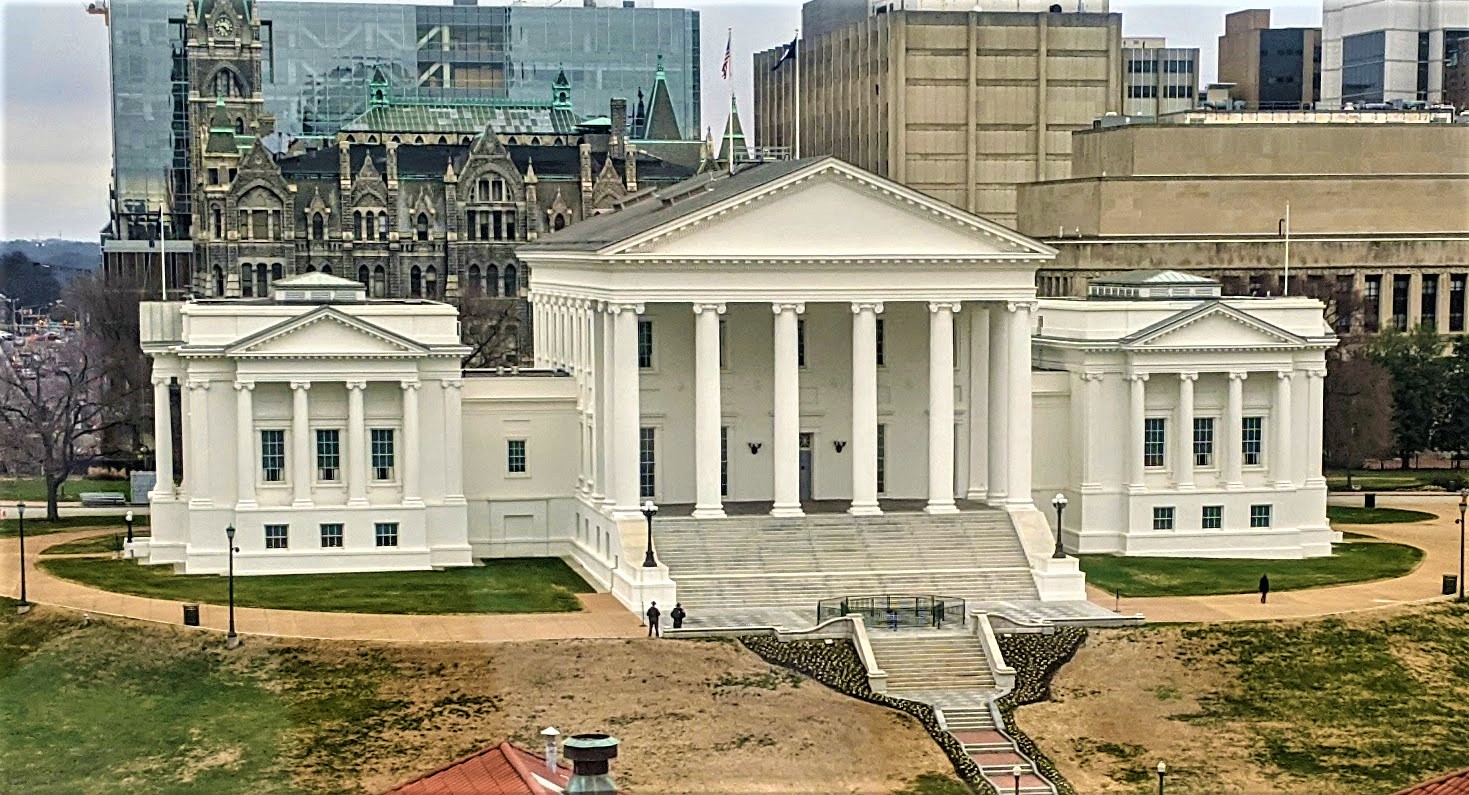
When we succumb to this sort of thinking, we get the results of the gerrymandering amendment, where half of Virginia believes they can disenfranchise the other half of Virginia provided they can whip themselves into enough of an emotional frenzy.
Comes right back to this:
Once you get to seeing your opposition as the enemy, the game is over. Soren Kierkegaard reminds us that you can do the most terrible things to another person if you do them on principle. When you turn people into abstractions and refuse to see them as the imago Dei then what else do they become but objects to be eradicated and destroyed in service to the highest good?
Ordered Lawmaking vs. Political Coercion
St. Thomas Aquinas defines lawmaking as the ordinance of reason for the common good made by those who have care of the community and rightly promulgated. Just to break it down a tad:
Ordered in the fullest sense of the term. If it were a puzzle piece, it would fit. Not something you have to hammer in.
Rational and reasonable. Not emotive or reactionary (or revolutionary) but a proper and ordered move.
For the common good. Note that Aquinas doesn’t say “highest good” as in what one might think every good person should do or be, but rather something that is a rational and ordered good for all concerned.
By those who have care of the community. Lawmaking for Aquinas isn’t merely human law but can also be good custom. Did you shower today? Did you do your laundry? Did you comb your hair? Brush your teeth? Those who ask others to live an ordered (aha!) and rational (aha x2!) life do so not just because it is good for you but because it is good for us all.
Rightly promulgated. Folks have to know about it.
Interesting to me is that in the legal arguments against the gerrymandering amendment that the Supreme Court of Virginia will be holding on Monday, the Virginia Democrats succeeded in violating just about every principle of good lawmaking — an argument Jason Miyares makes plain in his op-ed for the Richmond Times-Dispatch.
Yet in the very same way Virginia Democrats have reached for bad process when it comes to gerrymandering, so too do other actions which patently violate the law, and none more egregious than violence in the pursuit of the political.
Now there is a lot of debate about this. Herbert Marcuse will argue that lawmaking has the effect of violence in the sense that there is little difference between one who forcibly steals your things vs. those who prevent you from aspiring to those things at all. This sentiment fueled the violence of the 1960s before fading out in an ocean of cheap stuff, but the net effect is prisoner’s dilemma — where if one player doesn’t get maximalist ends, they burn it all down or in economists terms, refuse the deal.
Leftists are simply banking on the fact that power always has more to give. The problem, of course, is that not every conservative is a millionaire. Most of them are the folks who do the working and living and dying in this town — and when you treat them as evil, strip them of their rights, arrogate the role of government in the education of their children, indoctrinate them in universities to hate their own values, strip them of their Second Amendment on the path to restricting their First Amendment right to even whimper in protest before a school board? Even strip them of representation in a 51-49 vote so as to produce a 91-9 result?
No one is going to define that as either political or fair.
When we run roughshod over the laws, when we run roughshod over the constitution, that’s where the common ground by which we agree to live together begins to crumble. Those who instinctively see the danger aren’t speaking out of a willingness to pay others back in their own coin. Rather, if we cannot agree that words mean things, that constitutions should be tampered with slowly and deliberately, when we are willing to get what we want in disordered, irrational, and disproportionate ways?
Then what use is lawmaking?
What Marcuse misses is that lawmaking does have an element of force and coercion, but this is precisely why we wrap up lawmaking in layers upon layers of deliberation, elections, process, federalism, divided legislatures, executive authority, and judicial review and restraint. Madison knew what Montesquieu and Aquinas and Augustine and Cicero and Plato all echoed in their own ways — the balancing of the factions was the only way to prevent the demos + kratia (the brute force of the mob) from ruining the political commons.
When those passions are fomented by those who demand “maximum warfare” is it any small wonder why we see lone wolf terrorists who justify their actions by the rhetoric of those who have little to lose personally but everything to gain?
Once Again: Physician, Heal Thyself
There are few things more odious than “both sides” argumentation when it comes to such violence. Each and every act can stand on its own legs, and each and every act can be rightly condemned.
Yet there does have to be a moment when we as a public realize that this is not a “both sides” moment when it comes to the likelihood of violence. Once again, when we have a political ideology where 1 in 4 adherents believe that political violence is an option? We have a problem.
source: YouGov
Among conservatives? Just 6%.
This disparity can no longer be conveniently ignored. January 6th? How’s about three dozen cities with billions of dollars in property damages whose downtown districts have yet to recover. Or the state capitols raided whenever someone dares to question the abortion industry’s incessant demands for more, more, more? Three assassination attempts in two years. Rep. Steve Scalise among others. A Minnesota House Speaker assassinated by a man who claimed to be acting on orders from Governor Tim Walz? The near assassination of U.S. Supreme Court Justice Brett Kavanaugh? The near assassination of the White House Budget Director Russell Vought? Pennsylvania Governor Josh Shapiro — a man who Democrats denied the chance to run with Kamala Harris for vice president because he was Jewish — had his home firebombed by a “globalize the intafada” terrorist.
Charlie Kirk committed the thoughtcrime of seeking public and civil open debate on college and university campuses — and was assassinated.
This goes deeper than just public intellectuals and politicians. It has been five years since the iconoclasts succeeded in their task of destroying public monuments to civility in the wake of fratricidal warfare. Christopher Caldwell — no intellectual slouch and certainly no apologist for knuckledraggers — gave the riposte to the spirit of the times in the pages of the Claremont Review in 2021:
This is what many iconoclasts of our day sincerely believe. One of the great contemporary delusions is to assume that, when rioters tear down a statue of Thomas Jefferson or demand that an Abraham Lincoln school be renamed, they are demonstrating their historical ignorance, and have somehow “got the wrong guy.” Oh, no. They reject the idea that the Civil War was fought between a morally pure North and a morally irredeemable South. In this they have a point. The war was indeed fought between two sections that had each tolerated slavery to varying degrees, and finally faced an irreconcilable difference over whether any part of that institution could be tolerated. But there has been a shift in our understanding of what this means. Whereas earlier Americans understood slavery primarily as a problem of liberty, today’s Americans understand it primarily as a problem of race. It seemed for several generations that the end of slavery had removed the only obstacle to honoring both sides of the Civil War. But in the newest generation, the persistence of American racial prejudice can be a reason to honor neither.
Although there may have been ambivalence about the war’s origins, there was none in its resolution. “In the course of three and a half years,” wrote the British military historian Spenser Wilkinson a century ago, “the resistance of the Confederacy was crushed, its cause lost, and every interest and principle that had been invoked in its behalf abandoned for ever.” Abandoned forever is right. Whether they were erected in that spirit or not, Confederate statues, road names, and ceremonies today betoken the settlement of the constitutional and moral question from which the Civil War arose—not the reopening of it. (emphasis added)
Though the (post)modern narrative changed about what the monuments meant, the argument encompassed men such as Matthew Fontaine Maury, Thomas Jefferson — whose statue at the University of Virginia still remains in jeopardy — and even so far as to reach the eminence and scope of General George Washington himself.
We had our monuments to civility — and they were torn down.
If The Ends Are Honorable, So Too Should Our Means Be Honorable
Quintilian — the famous Roman orator and educator from which many who seek to improve Virginia public education system would find both a reformer and an ally — rejected the old Ciceronian dictum that the purpose of oratory and rhetoric was the art of speaking to as to persuade. Instead, for Quintilian the purpose of oratory and rhetoric is the good man speaking well.
“My aim, then, is the education of the perfect orator. The first essential for (the orator) is that he should be a good man, and consequently we demand of him not merely the possession of exceptional gifts of speech, but of all the excellences of character as well.”
— Quintilian, Institutio Oratoria, Book XII, Chapter 1 (88AD)
Now color me skeptical, but I don’t believe that Hakeem Jeffries calling for “maximum warfare” against his political enemies exhibits any excellence of character. Nor does putting two bullets into one’s political enemies or fantasizing about watching his children die in their mother’s arms exhibit the qualities of a good man.
In fact, it isn’t good at all — it isn’t rational, it isn’t ordered — and therefore isn’t the basis of any good lawmaking in pursuit of the common good.
This comes back to a common refrain: how one does a thing is just as important as what the thing is. If your ends are honorable, so too should your means be honorable. This is why violence in the pursuit of the good is never the correct answer (pace Pope Leo XIV). One can gerrymander one’s intention to say that such violence just might be self-defense, but in doing so the argument is betrayed from the start. Edward Feser notes this complication as he argues against the propriety of the conflict with Iran:
These arguments imply that just war doctrine allows one to support a war as long as some plausible argument can be given for it, even if not a conclusive argument. This is not the case. What has long been the standard teaching in the Catholic just war tradition is that the probability of a war’s being just is not good enough. The case for the justice of a proposed war must be morally certain. Otherwise, it is morally wrong to initiate the conflict. It follows that, if writers like Reno, Royal, and Maier acknowledge that the case for the war is debatable at best, then they should oppose the war.
The option for violence requires more than a theoretical supposition or a probability, exhausting all other possibilities. Self-defense cannot be probably just but rather it must be morally just — with all other possibilities exhausted.
One should find it impossible to defend options for violence in a polity where good lawmaking, constitution process, and mutual respect prevail. One worries that the political left is on course and without self-correction to do the opposite without broad gestures towards equivocation and abstraction.
Yet for conservatives, we should worry a great deal more about contagion or the rationale that fire can only be fought with fire.
That sentiment was heard all too often by political defenders of the recent gerrymandering amendment as a defense both of their violation of constitutional norms as well as justification for the disenfranchisement of half of Virginia. There has been a decade-long debate within the Republican Party, as conservatives have been forced to bear the brunt of the critique as if the rise of the progressive left were somehow predicated by concessions of the conservative right — a foolish argument peddled by fools.
Conservatives know better — not only were free markets, free minds, and a free society the tools used to utterly destroy Soviet Communism, but such tools lifted billions of people out of poverty worldwide and cemented the Pax Americana. We know that good argument drives out bad argument, that there is a radical bet on human freedom predicated on our desire to pursue the good, beautiful, and true, and that above all else that there is nothing that is wrong with America that cannot be resolved by what is right about America.
Webster: “Any attempt…should be met by one universal burst of indignation…”
Too many on the left and the right believe otherwise. That mankind must be managed, corralled, and steered. That the power to do these things should never be surrendered into the wrong hands, and if they are, then a maximalist sort of warfare should be waged against them knowing full well what they would do to us if such power fell into the hands of any opposition.
On the commemoration of the Battle of Bunker Hill in 1825, no less an authority than Daniel Webster reminded Americans why the specter of violence was and remains totally incompatible with human freedom and good government:
Let us thank God that we live in an age when something has influence besides the bayonet, and when the sternest authority does not venture to encounter the scorching power of public reproach. Any attempt of the kind I have mentioned should be met by one universal burst of indignation; the air of the civilized world ought to be made too warm to be comfortably breathed by any one who would hazard it.
That we are forfeiting the universal burst of indignation from the civilized world alludes not just to the barbarism violence introduces, but to a sterner reality that too few of our public figures are civil — much less civilized.
Much of this can be resolved in our civic discourse. Some of it should be resolved in our own education — a process that should never stop after the last sheet of paper has been handed over.
Yet there’s an alarming sentiment that such goodwill simply isn’t being met by our friends on the left. Not all of them — but an alarming number of them.
The mistake would be to “fight fire with fire” in the words of Virginia Democrats, by taking their example and turning it into instruction.
Are we there yet? For myself, I’d agree with voices such as Feser — not quite. Yet if the social media accounts of Virginia Democratic leadership are telegraphing the punch, then it is no small wonder why civility and constitutional process are bending under the weight of rhetoric and violence.
Pointing it out helps. Tamping it down among friends is even better. For myself, I still believe good argument is the antidote to bad argument. Our problem today is that good argument is being met with bullets — actual and metaphorical — and peals of laughter online when the shot either connects or is a near miss.
Here is hoping for Webster’s universal burst of indignation. Calls for maximum warfare or “fighting fire with fire” aren’t it.
SHAUN KENNEY is the senior editor for The Republican Standard.
Originally published by Shaun Kenney at The Republican Standard Substack. Republished here at Virginia Liberty.